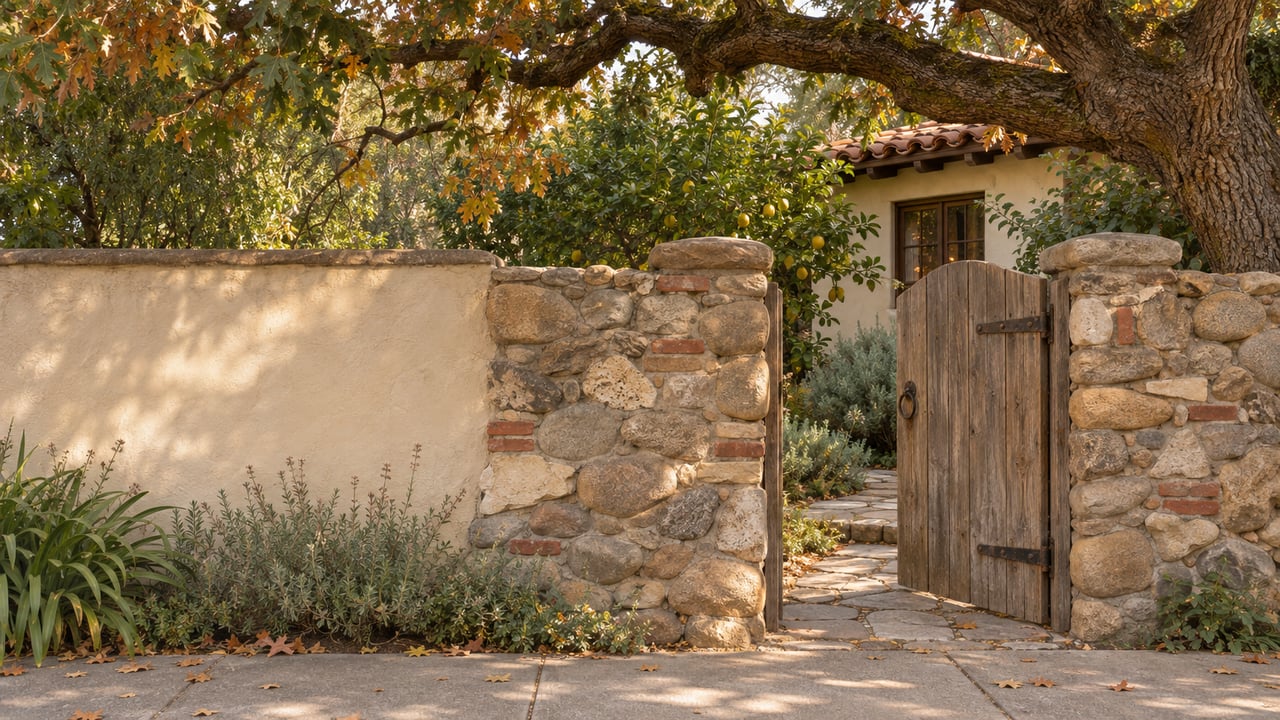
The walls along the 300 block of South Mills Avenue are made of field stone, mountain boulders and street pavement broken up after a flood. Several roofs carry red tile salvaged from buildings condemned after the 1933 earthquake. One house has more than 2,500 concrete blocks chiseled from street rubble, according to a 1988 Los Angeles Times account of Russian Village. This spring the newest material came to the same corner: colored stamped pavement for a raised intersection at Mills and Cucamonga Avenues. The residents picked the color.
There are 15 houses in all, at 290 through 370 South Mills. Most Claremont residents have driven past them on the way to Arrow Highway. Fewer know that the block was put together by its own residents, or that the same habit of neighbors deciding things together set the look of the street a century later.
A Steelworker, Some Citrus Land and a Pile of Rocks
Claremont Heritage names the original landowner as Polish immigrant Konstanty Stys. According to the Times, Stys came to the area in the early 1920s from Youngstown, Ohio, where he had worked in the steel industry. Construction work at the Claremont Colleges drew him here, and he bought a plot among the citrus groves of south Claremont. He found his building material close by: the piles of rock farmers had cleared from the surrounding land to make it farmable. He added boulders hauled down from the mountains and leftover lumber from the college job sites, and in 1922 he finished a modest house that set the rocky, rustic style for everything after it.
The Depression turned one house into a neighborhood. Stys split up his land and sold lots on easy terms to friends, relatives and co-workers who had lost everything. The Times reported mortgage payments as low as $5 a month, and some months they went uncollected. Stys also gave the new owners his labor and his talent for finding cheap materials. Claremont Heritage dates the 15 homes from 1923 to 1939. It says Stys helped his neighbors find materials in wrecking yards and earthquake-damaged buildings, and that the houses share rock and street-rubble exteriors, red-tile roofs and an informal layout on each lot.
The neighbors copied his style because they had to. All but one of the homes were built without blueprints, so the floor plans followed whatever supplies turned up and whatever a growing family needed. A 2023 feature in La Verne Magazine found railroad ties used as ceiling beams inside one house, and it reported that some exterior walls hold material from a school board building that fell in the 1933 Long Beach earthquake.
Judy Wright was Claremont's mayor at the time and a former president of Claremont Heritage. She told the Times that "old-timers in Claremont talk about how Mills Avenue used to look like a junkyard because of all the rubble that was down here," and called Stys's eye for that rubble one of his talents.
A Polish Builder and a Russian Name
Stys was Polish. The usual explanation for the name, as the Times told it, is that neighbors heard his accent as Russian. A second story holds that some Claremont residents of the time saw a hint of Bolshevism in a cooperative community of immigrant workers who built houses for one another. Either way, the name stuck.
On December 28, 1978, the houses went on the National Register of Historic Places as the Russian Village District, according to California State Parks' Office of Historic Preservation. The Heritage tour calls them a prime example of folk architecture.
Three Years of Meetings for One Intersection
The houses have stayed handmade, but the street in front of them changed around them. Mills Avenue runs straight to Arrow Highway, and the City has been working on traffic there since January 1997. That year a traffic study led to raised medians and a rock-lined monument "to create a sense of entry and identity," a three-way stop at Cucamonga and South Mills, and a lower speed limit, cut from 35 to 25 mph. That history is in a November 25, 2025 City Council staff report.
The same report says complaints about traffic volume and speed kept coming in. On January 26, 2023, a large number of Russian Village neighbors came to the Traffic and Transportation Commission and asked for a new traffic investigation. City engineers and the Claremont Police Department held a neighborhood meeting on February 21, 2023, and staff wrote that people there agreed on a need to improve safety and lower speeds "while preserving the historical nature of the area." Speed data followed, and a City consultant worked on the residents' concerns about speeding, safety, heavy trucks and accessibility. The consultant's recommendations went back to the neighbors at a second meeting on August 5, 2024. According to the staff report, the neighbors supported them as "creative and sensitive to the historic nature of the area."
The plan put a speed table at Mills and Cucamonga, meant to get drivers to obey the stop signs and to slow traffic. It is surfaced in colored asphalt, and the color was chosen by the residents and reviewed and supported by Claremont Heritage. The plan also included new sidewalk landings and ADA ramps at the intersection, green bike lanes, ladder-style crosswalks and curb markings. When bids came in on November 6, 2025, ten contractors had competed. The lowest, We R Builders of Riverside, bid $207,476, against a high of $377,983. The City's budget for the job came to $228,224 with contingency, paid from ARPA, Measure M and TDA funds.
The crews started on Monday, April 20, 2026, between Moreno Street and Arrow Highway. They pulled up the old asphalt and laid the raised intersection in colored stamped pavement. Delays kept Mills closed around the clock between Moreno Street and Oakdale Drive into May, with reopening set for Saturday, May 9, according to the City Manager Weekly for May 7, 2026.
The Depression-era neighbors built their walls out of the street's rubble. Their successors spent three years of meetings on how Mills Avenue should slow down, and then chose the pavement color for the corner where those walls stand.
A Short Walk for the Long Weekend
The Russian Village homes are private and lived in. They are meant to be seen from the public sidewalk, not from the yards. Over the Thanksgiving weekend, the block makes a good walk to show visiting family, and it connects to a second stop on the same historic route.
- Start at Mills and Cucamonga Avenues and walk the 300 block of South Mills. Look for the rock and rubble walls, the red-tile roofs, and the way no two lots sit quite alike.
- Follow the route from a 2020 Claremont Courier walking tour: head west on Cucamonga Avenue, then turn south on Sycamore Avenue.
- End at Oak Park Cemetery, 410 Sycamore Avenue, which the City keeps open to visitors every day from dawn until dusk.
The cemetery fits the Village's story. Thomas Barrows bought the land in 1897 so his sister Octavia would have a proper resting place, and he became the second person buried there. The 20 acres hold oaks, sycamores and palms. Buried there are founders of the town and of the Claremont Colleges, along with citrus workers and grove owners. Those are the colleges whose construction work brought Stys to Claremont and the groves whose cleared rocks built his first house.
To hear the rest of the town's history from a docent, Claremont Heritage holds its last guided Historic Claremont Village walk of 2026 on Saturday, December 5. Walkers meet at 9:45 a.m. at the historic Depot, 200 West First Street, now home to the Claremont Lewis Museum of Art. The tour covers about two miles from 10 a.m. to noon and costs $20 per person, and reservations are required through Claremont Heritage or by calling 909-621-0848. That route stays in the Village. Russian Village is part of Heritage's self-guided Indian Hill Blvd. and nearby tour, which you can walk any day. For more on the town around both routes, our Claremont neighborhood page and our earlier look at the Village's fall storefronts and calendar pick up from there.
Houses built by hand from salvaged stone and earthquake tile don't line up neatly against the house down the street, and that is where an appraiser's training matters. If you own an older Claremont home whose materials and history make it hard to compare, The Mowery Group combines brokerage experience with certified appraisal work to give you a value you can defend. Schedule a free consultation, and we will start with what makes your house different.